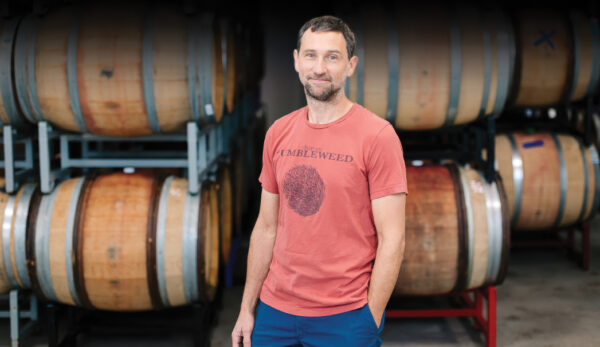
SEDONA MONTHLY: Where are from originally?
JOE BECHARD: I grew up in Boise, Idaho.
How did you get interested in winemaking?
Well, it’s kind of a long story, but it really goes back to my wife [Kris Pothier, a co-owner of Chateau Tumbleweed, general manager and label artist] and I met while I was going to college at the University of Oregon, and we were both working in a restaurant. And it was a cool restaurant in that it had a lot of local wines and a lot of fun wines from around the world. And the owner was awesome. She let us finish off the bottles at the end of the night and drink a lot of wine at her bar. So, we fell in love with Oregon Pinot. Specifically, while we were at Turtles Bar and Grill in Eugene, and I was going to journalism school and was not planning on getting into wine at all. I took a job with the Sedona Red Rock News. My first reporting job out of college. And that’s where I learned there was a small, but burgeoning wine industry in Arizona. And then I switched gears and went from enjoying wine to making it in 2005.
Did you go to school to learn winemaking?
I did not go to school for making wine. I went to the school of hard knocks and have been learning on the job. I put 10 years in working for other wineries in Arizona before we started Chateau Tumbleweed.
Did you have any mentors?
My first five years, I worked with Eric Glomski at Page Springs Cellars. He was certainly the one who set me down my path. And I think he and I saw wine very similarly and shared a lot of ideas about wine. I think he was a great, great first mentor to have.
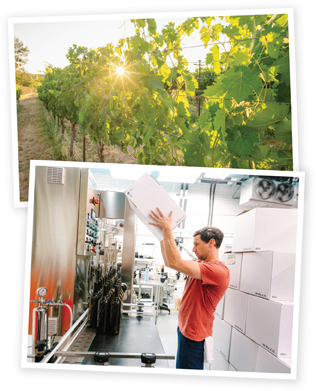
Top: Vines at the D.A.Ranch estate.
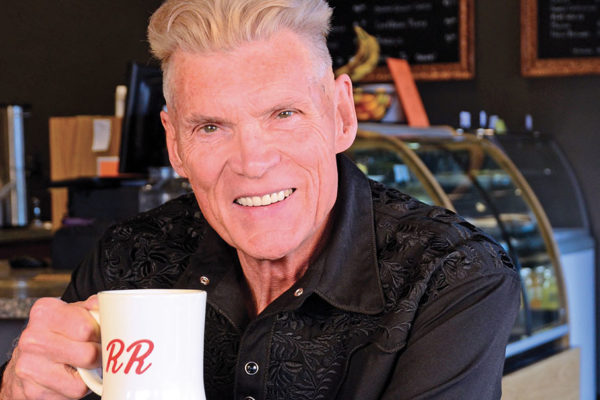
Bottom: Chateau Tumbleweed and D.A.Ranch winemaker, Joe Bechard.
What did Eric Glomski teach you?
For me, I enjoy wines that are not too much of anything. So wines that are very balanced, and wines that have finesse and are more about beauty than power. That was something that Eric and I shared, and it’s something that’s been important to me since then. Working with him really reinforced that and allowed me to explore more of wine.
What do you mean by “you don’t want wine to be too much of anything one thing?” Could you expand on that?
Wine is all about balance in my mind. So, if a wine is too tannic or too dark or too bold or too light. You’re looking to get a balance and a complexity of the number of characters. And I think you get that not by always making the most powerful wine or the most light wine.
What’s one of the hardest things about making wine?
It’s trying to represent nature as best you can, and so you learn how to handle changes. We work with a lot of different vineyards. So we get to see a lot of different stuff and a lot of things happening. You learn how to react, but it’s more just trying to shepherd these grapes from something that’s kind of temporal and short lived into something that can last for years, decades. For me, the challenge is trying to preserve the beauty that you got from nature, from these grapes, and trying not to get in the way too much and not to muck it up.
What do you personally like about wine?
To me, wine is kind of a tribute to nature. The artist in the whole thing is nature and in the way it makes this like beautiful vessel, this grape to make wine that’s so perfect for making wine. And then the way the yeast takes those grapes and unlocks a whole new world of flavors and aromas. I love that we can take this natural product and preserve this harvest for many, many years in the future, and we can go back and reflect on it. The first and most important thing is that wine always takes me to nature and to how amazing and complex and beautiful nature is and how little we revere it, but we should probably give it a little bit more reverence.
Is there any one wine that was important in your development?
We have a blend called Willy, and it’s a blend of grenache, syrah and tempranillo. And that is a wine that’s kind of an homage to Oregon pinot noir, where we fell in love with wine, and it’s our effort to make something that seems familiar to Oregon pinot, and I think through coming up with that blend, I think it’s taught me a lot about how I see wine and blending. One thing that we do a lot of is blending on darker and lighter components to try to bring balance. It’s taught me it’s OK to make wines with finesse and that are a little delicate, and they don’t all have to be big powerhouses. Through putting together a few of our blends, I think that’s when you really get to know your wines and who you are as a winemaker.
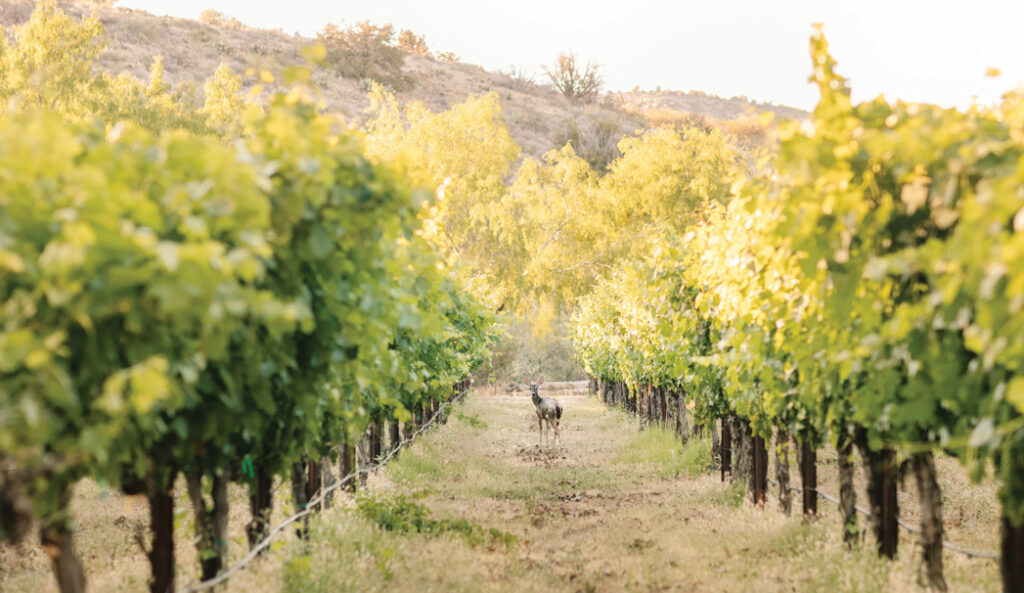
Vineyards at D.A.Ranch in Cornville.
You’re also the winemaker for D.A.Ranch. How are the wines you make for D.A.Ranch different than the ones for Chateau Tumbleweed?
Well, the first thing is, all of D.A.Ranch’s fruit comes from their own vineyards, whereas we are fruit sourcers so we buy fruit from other vineyards. All of their fruit is Verde Valley fruit, and most of ours comes from Willcox. So those are some of the obvious differences. And then they have their own program built around their vineyard. So they’ve got seyval blanc as their white wine, their Willow White, and they have malvasia. I think a lot of their approach, they started their winery well before we started working with them. I actually made their first wine with Page Springs Cellers back in ’06 or something. But they had a pretty established portfolio and knew what they were doing. Their thing is they have their reserve wines, which are extended aged and get a little bit more oak. We do a little bit of extended aging, but those wines get a little bit more oak than anything at Chateau Tumbleweed. They’ve got their blends. They’re all based on their fruit and how their program shakes out. The winemaking is similar in that it’s a similar approach, but it’s their vineyard, their vision, their portfolio, their program. The nice thing is they give me quite a bit of latitude to do what I think is right, and hopefully, I do that … I try to follow what they built and what they’re going for and try to put my own touch of keeping things nice and clean and tidy and expressive.
You mentioned putting your own touch on things. What do you mean by that?
It’s all about balance and bringing together power and finesse and spice and fruit. As many layers as you can and then trying to make it not be too much of anything. And I like wines that are fresh and a little crunchy, a little vibrant. They’ve got energy to ‘em. I really try my best to do that with our wines.
What do you feel makes Arizona wine unique?
The most important thing is elevation. Most of the grapes are between 3,500 to 5,000 plus feet. The elevation is super important, the dirt, the clay in the soils, the weather. The fact that we have monsoons in the middle of harvest sounds crazy to some, but without those monsoons, we would probably not have wine. There’s just so many unique things about Arizona that make it special, and then it translates to the wines, and you get these really spicy wines. I love spicy wines, and there’s just so many spicy grapes to work with in Arizona. There’s a really neat red fruit and a red clay, earthy note that you see in Arizona. You get a neat harmony or tension between acid and tannin in Arizona that is hard to find. Arizona wines are very unique and special, and I’m really excited about them and proud of them and hope that other people will be as geeked out by them as I am.
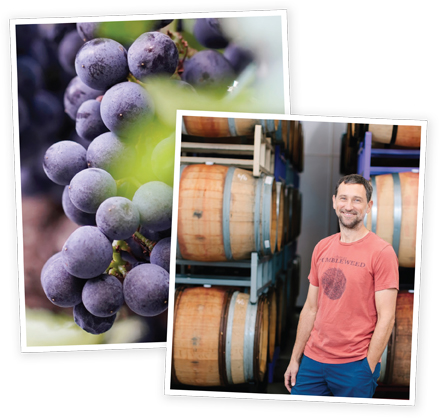
From left to right: Syrah grapes on the vine at D.A. Ranch. Winemaker Joe Bechard in the barrel room at Chateau Tumbleweed in Clarkdale.
Chateau Tumbleweed sources grapes from many different vineyards. Is that challenging?
It’s bordering on insane. We rent a refrigerated truck that can haul six tons at a time. And basically, that truck is going down to Willcox and coming back with fruit every other day. And then on the days that we’re not receiving fruit from Willcox, we receive fruit from D.A.Ranch. And so not only are you coordinating two trucks, but you’re coordinating multiple vineyards. We have our business partner, Jeff [Hendricks], down in the vineyard testing, constantly helping us decide what needs to pick and when, coordinating what goes on what truck. It’s a logistical feat, a nightmare, but I love it, and it’s something that I really enjoy about our place in the world is that we’re able to do that and bring so many cool grapes up here. And people can contrast three different syrahs or a couple different cab francs. It gives our customers a chance to taste different things.
Why do you source your grapes from all Arizona vineyards?
That’s just where my heart is. I have worked with California grapes in the past. I’ve worked with New Mexico and Colorado grapes, but my heart is in Arizona, and I think we have something special here. And I’ve basically dedicated my life to Arizona wine.
Do you consider yourself to be an ambassador for Arizona wine?
Yeah, absolutely. I think that’s a huge part of what we do. And I think it’s important when you’re in such a small and young industry that you support one another. The rising tide lifts all boats. We’ve tried to collaborate and work with as many of our colleagues as we can.
What do you feel makes a good wine?
For me, it’s all about balance, and it’s all about not trying to do too much and really just letting the fruit ferment and be its own thing and not trying to make the grapes be something else. I love balanced wines. I like wines with a little bit of acidity and some tannin, with a little bit of juiciness to them. There’s so many great wines. I love so many wines that I can’t really say, “This is the rule to a great wine,” but it’s got to be done with love and reverence for nature and the least amount of ego possible.
How do you know when you’ve made a good wine?
They just kind of speak to you. When you taste a lot of wine, you just have these moments where you’re like, “Oh, man.” … It just kind of hits you in a way, like, “Oh, this is something different.”
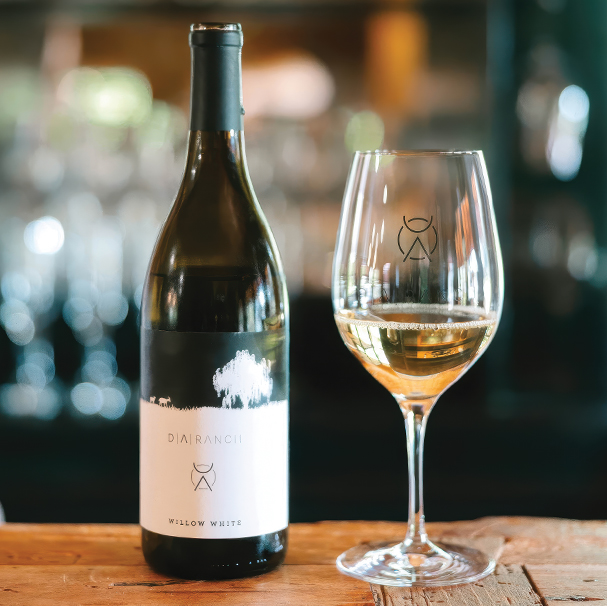
The current vintage of Willow White, a wine made of seyval blanc grapes from D.A.Ranch vines.
Is winemaking an art or a science?
It’s probably more of a science. I mean, to me, nature is the artist, and I’m kind of a shepherd. I just am trying to make this fruit ferment clean and nice. It’s gonna ferment one way or another. My job is just to make sure it does it in them in a way that makes good wine. I don’t like to talk about wine as art, because it makes it feel like … it’s a little pretentious. I really don’t want wine to be pretentious. Wine should be accessible to everyone.
How do you feel like you’re making wine less pretentious?
By trying to make it fun. We’ve been trying to have a good time here and trying to give people a lot of variety and a lot of options and to really show people your passion for this. I think it’s contagious. It’s definitely a goal of ours is to not be all stuffy and pretentious and to really allow people to come in and taste and see what they like and learn about their palettes.
Is there anything else you want to say about making wine less pretentious?
It’s a shame, really. We’ve treated wine like this, and marginalized it so much, made it a thing for the wealthy and for elites, and it’s never what wine has been. Wine has inspired artists and thinkers and musicians for centuries.
How would you like your work to be remembered?
All I would hope is that our contribution to Arizona wine is remembered.